TFL-CC PCN: Congestion Charge: failure to pay the daily charge for driving in the Congestion Charge zone
Received a PCN with contravention TFL-CC? This TfL charge code is enforced by CCTV cameras on UK streets. Upload your notice and Parking Mate AI checks it for defects.
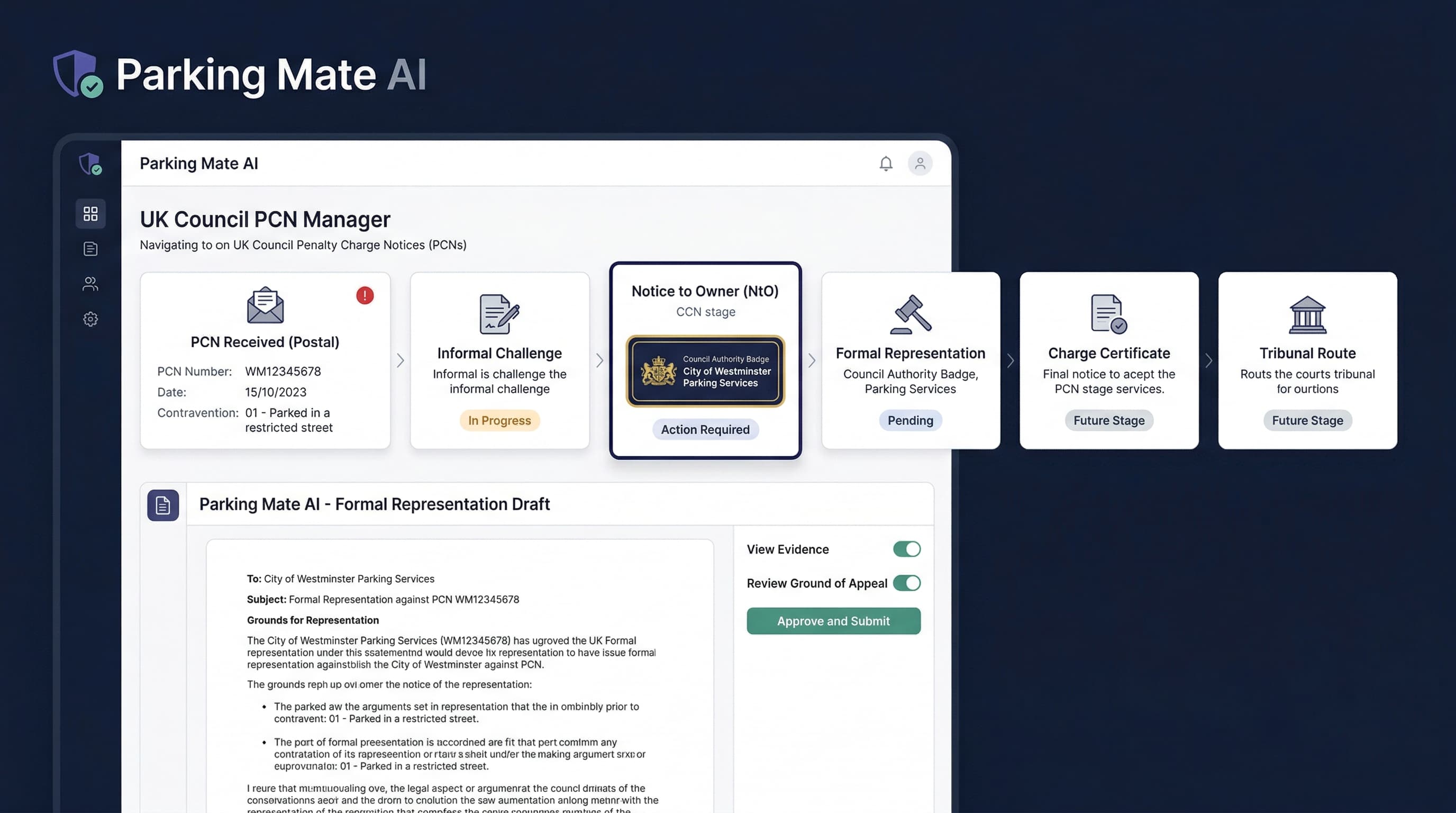
Contravention TFL-CC means: Congestion Charge: failure to pay the daily charge for driving in the Congestion Charge zone. This is a TfL charge contravention enforced by CCTV cameras on public streets. If you have received a PCN with this code, it does not automatically mean you must pay. Many PCNs with TFL-CC contain defects in signage, procedure, or evidence that can form the basis of a successful challenge.
What a TFL-CC PCN means for you
If you have received a penalty charge notice with contravention TFL-CC, it means the council considers that you congestion charge: failure to pay the daily charge for driving in the congestion charge zone. This is classified as a TfL charge contravention and was captured by CCTV camera.
However, receiving a PCN with TFL-CC does not mean you must accept the charge. The council must have followed strict rules when issuing the notice, including having proper signage, using the correct contravention code, providing clear camera evidence, and serving the notice within the statutory time limit.
Upload your TFL-CC PCN and Parking Mate AI checks it against all the requirements that apply to this specific contravention. If defects are found, you can get a professional challenge letter ready to send to the council.
What we check on a TFL-CC PCN
Vehicle exemption or compliance
Your vehicle may be exempt from the charge (for example, disabled badge holders, certain ultra-low emission vehicles, or vehicles registered for an exemption). If your vehicle qualifies, the PCN should not have been issued.
Payment system errors
If you attempted to pay but the system failed, did not process your payment, or you were not given adequate opportunity to pay, this may form grounds for challenge.
Incorrect vehicle identification
The ANPR camera must correctly identify your vehicle registration. Misreads, cloned plates, or errors in the DVLA record can lead to incorrect PCNs.
Signage at zone boundaries
The boundaries of the Congestion Charge zone, ULEZ, or LEZ must be clearly signed. Inadequate signage at entry points can be grounds for challenge.
Recent vehicle change or modification
If you recently changed your vehicle or had it modified to meet emissions standards, the DVLA records may not have been updated. This can result in an incorrect PCN.
Procedural and timing defects
TfL must serve the PCN within the statutory time limit and follow the correct procedural steps. Late or defective service can be grounds for challenge.
Evidence to gather for a TFL-CC challenge
A photo or copy of the PCN itself
Photographs of the signage and road markings at the location
Any dashcam footage from the time of the alleged contravention
Any earlier or later correspondence from the council
A written record of why you believe TFL-CC does not apply or was incorrectly issued
Related pages
Enforcement Scheme
View the enforcement scheme that covers TFL-CC.
Council PCN Help
Browse all council penalty charge notice help by notice type.
All Contravention Codes
Browse all UK parking contravention codes and what they mean.
TFL-ULEZ: ULEZ: driving a non-compliant vehicle within the Ultra Lo...
ULEZ: driving a non-compliant vehicle within the Ultra Low Emission Zone
TFL-LEZ: LEZ: driving a non-compliant vehicle within the Low Emiss...
LEZ: driving a non-compliant vehicle within the Low Emission Zone
Contravention TFL-CC FAQs
Common questions about this contravention code and how to challenge it.
What does contravention TFL-CC mean?
Contravention TFL-CC means: Congestion Charge: failure to pay the daily charge for driving in the Congestion Charge zone. This code is used on on-street penalty charge notices and is enforced by CCTV cameras. If you have received a PCN with TFL-CC, it means the council considers that this specific contravention occurred at the time and place stated on the notice.
Can I challenge a PCN with contravention TFL-CC?
Yes. A PCN with contravention TFL-CC (congestion charge: failure to pay the daily charge for driving in the congestion charge zone) can be challenged if there are defects in the signage, procedure, evidence, or if the code does not accurately describe what happened. Many PCNs with TFL-CC contain enforceable defects that are not obvious at first glance.
What defects does Parking Mate AI check on a TFL-CC PCN?
For a TFL-CC PCN (congestion charge: failure to pay the daily charge for driving in the congestion charge zone), Parking Mate AI checks whether the contravention code accurately describes what happened, whether the signage and markings comply with regulations, whether the camera evidence meets the required standard, and whether the notice was served correctly and within time limits.
How long do I have to appeal a TFL-CC PCN?
For a PCN with contravention TFL-CC, you typically have 28 days to pay at the discounted rate or make an informal challenge. If a notice to owner follows, you have another 28 days for formal representations. If the council rejects your representations, you have 28 days to appeal to the independent tribunal. Check your TFL-CC PCN promptly to preserve all options.
Is a TFL-CC PCN always correctly issued?
No. A TFL-CC PCN (congestion charge: failure to pay the daily charge for driving in the congestion charge zone) may be incorrectly issued for several reasons: the wrong contravention code may have been used, the signage may be inadequate, the camera evidence may be unclear or incorrectly interpreted, or the procedural requirements may not have been met. Checking is always worthwhile.
What evidence should I gather for a TFL-CC challenge?
For a TFL-CC PCN, gather the PCN itself, photographs of the location and signage if possible, a note of the date and time, any earlier or later correspondence, and any dashcam footage that may show the circumstances. If you believe the contravention code is wrong, note specifically why TFL-CC does not apply.
What happens if I ignore a TFL-CC PCN?
Ignoring a TFL-CC PCN leads to escalation through the council enforcement process. After the initial PCN, the council issues a notice to owner, then a charge certificate (increasing the penalty by 50%), then registers the debt at the Traffic Enforcement Centre, and eventually pursues bailiff enforcement. Responding early keeps more options open.
Can the wrong contravention code be used on my PCN instead of TFL-CC?
Yes. Councils sometimes use the wrong contravention code on a PCN. If your PCN shows TFL-CC (congestion charge: failure to pay the daily charge for driving in the congestion charge zone) but that does not accurately describe what happened, this is a ground for challenge. The code must correctly reflect the specific contravention alleged. An incorrect code can result in the PCN being cancelled.
Does contravention TFL-CC apply on all streets?
Contravention TFL-CC applies specifically to the Congestion Charge zone administered by Transport for London. The zone boundaries and applicable rules are specific to this scheme.
How does Parking Mate AI help with a TFL-CC PCN?
Upload a photo of your PCN showing TFL-CC and Parking Mate AI reads the details automatically. It checks whether TFL-CC (congestion charge: failure to pay the daily charge for driving in the congestion charge zone) has been correctly applied, whether the signage and procedure meet the required standards, and whether the notice was served properly. If defects are found, you can get a professional challenge letter targeting the specific issues.
Got a TFL-CC PCN? Check it before you pay
Upload your penalty charge notice for a free Parking Mate AI defect check. If grounds are found for your TFL-CC PCN, get a professional challenge letter ready to send.
