Upload your notice
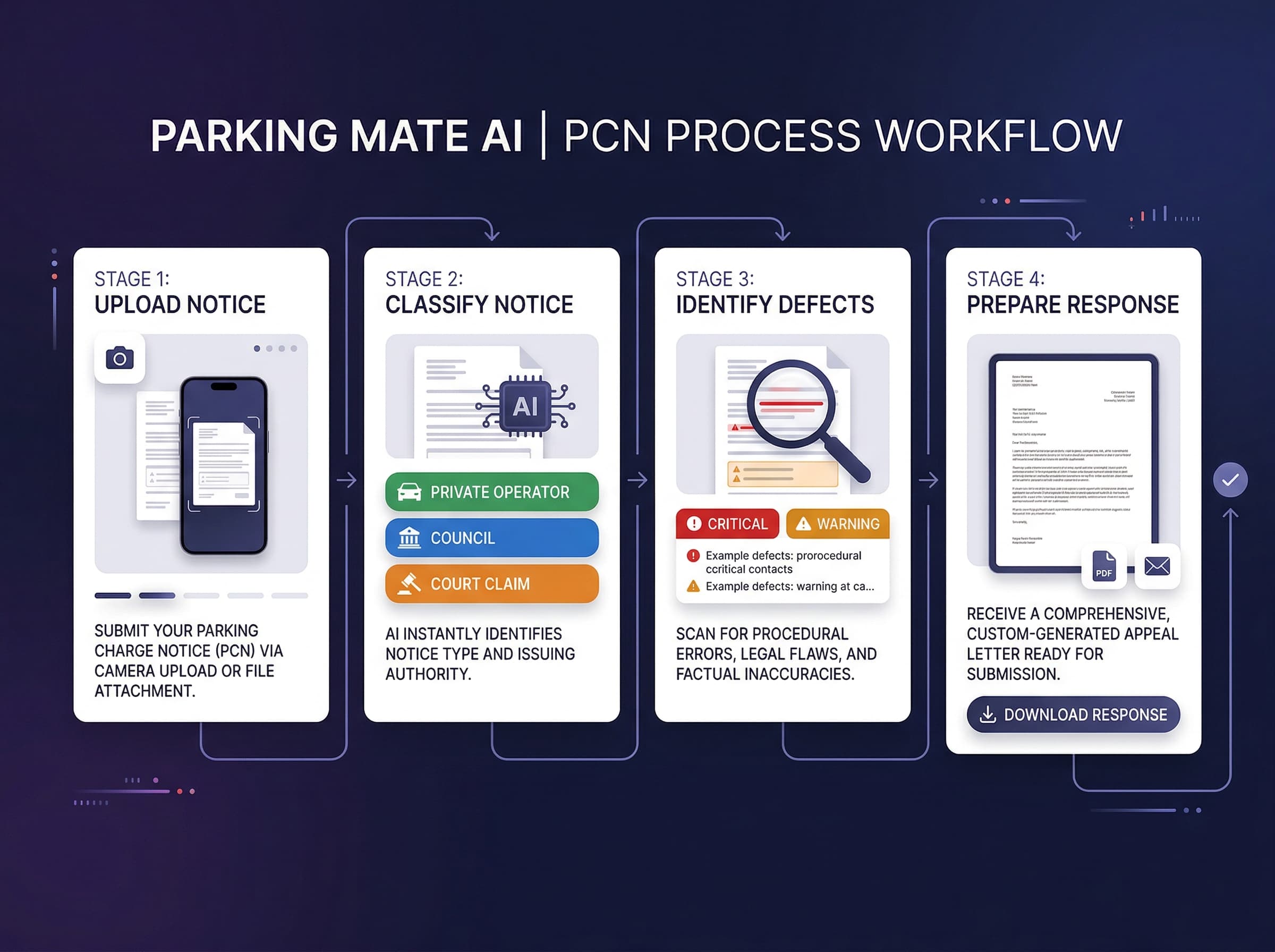
Take a photo of your parking ticket, penalty notice, or letter and upload it. Parking Mate AI reads and extracts the key details automatically.
Whether you have just received your first ticket or you are facing a court claim, find the right help for your exact situation. Browse by notice stage or go straight to your operator.
Ticket check
Parking charge notices and keeper notices
Debt letters, court claims, and CCJ help
Operator-specific help for ParkingEye, APCOA, and more
Start here if you are not sure what type of private ticket you have.
Learn morePre-courtReceived a letter threatening court action? Check your defences now.
Learn moreCourtCourt papers arrived? Get a structured defence for your private parking claim.
Learn moreOperatorHelp specific to ParkingEye tickets, appeals, and court claims.
Learn moreOperatorHelp specific to APCOA parking charges and appeals.
Learn moreDirectoryBrowse all operators to find help specific to your ticket issuer.
Learn moreThree steps from parking ticket to professional appeal letter. No legal jargon, no guesswork.
Take a photo of your parking ticket, penalty notice, or letter and upload it. Parking Mate AI reads and extracts the key details automatically.
Your notice is checked against signage rules, timing requirements, wording obligations, and procedural standards that the issuer must meet.
Receive a professional appeal or defence letter that cites the specific issues found, ready to send to the operator, council, or court.
Common questions about parking ticket appeals and how the service works.
A private parking ticket is a contractual claim, not a criminal fine. However, since the Protection of Freedoms Act 2012, private parking operators can pursue the registered keeper of the vehicle through the civil courts. Whether a specific private parking ticket is enforceable depends on whether the operator followed the correct signage, timing, and procedural rules.
A PCN (penalty charge notice) is issued by a council under statutory powers. A parking charge notice is issued by a private parking company as a contractual claim. They sound similar but have different legal foundations, different appeal routes, and different enforcement processes. Always check which type you have before deciding how to respond.
No. Since the Protection of Freedoms Act 2012 came into force in England and Wales, private parking companies cannot lawfully clamp or tow vehicles on private land. Their only enforcement route is to pursue payment through the civil courts. If a private operator clamps your vehicle, that may be a criminal offence.
No. Private parking tickets do not result in penalty points, do not appear on your driving licence, and are not recorded by the DVLA. They are civil contractual claims between you and the parking company. The only potential credit impact is if a county court judgment is entered against you and you fail to pay or have it set aside.
Private parking operators obtain keeper details from the DVLA using the vehicle registration number, usually captured by ANPR cameras. The DVLA charges a fee for each enquiry. Operators must be accredited members of a recognised trade association (BPA or IPC) to access DVLA data for this purpose.
The Protection of Freedoms Act 2012 (POFA) is the key legislation governing private parking enforcement. It allows operators to hold vehicle keepers liable for unpaid parking charges, but only if strict conditions are met, including adequate signage, a valid notice to keeper served within 14 days, and membership of an approved trade association.
Yes. If the operator rejects your initial appeal, you can escalate to an independent appeals service. BPA members use POPLA (Parking on Private Land Appeals). IPC members use the IAS (Independent Appeals Service). The decision is binding on the operator but not on you, so there is no risk in appealing.
The most common defects on private parking tickets include inadequate or missing signage at the car park, failure to serve the notice to keeper within the 14-day POFA deadline, incorrect charge amounts that exceed the operator's code of practice cap, and missing required information such as the appeal rights or the operator's trade association details.
The limitation period for a private parking contractual claim is six years from the date of the alleged contravention. However, most operators that intend to pursue a case will do so within 12 to 18 months. After six years, the claim becomes statute-barred and cannot be enforced through the courts.
Upload a photo of your private parking ticket and Parking Mate AI reads the details automatically. It checks against POFA requirements, the operator's code of practice, signage standards, timing rules, and wording obligations. If defects are found, you can get a professional appeal letter targeting the specific issues on your notice.
Upload your ticket or browse by operator to find help tailored to your exact situation.
