DWF Law court claim? Get your defence ready.
DWF Law has filed a county court claim? Get a structured defence covering the grounds that matter. Deadline: 14 days to acknowledge, 28 days to defend.
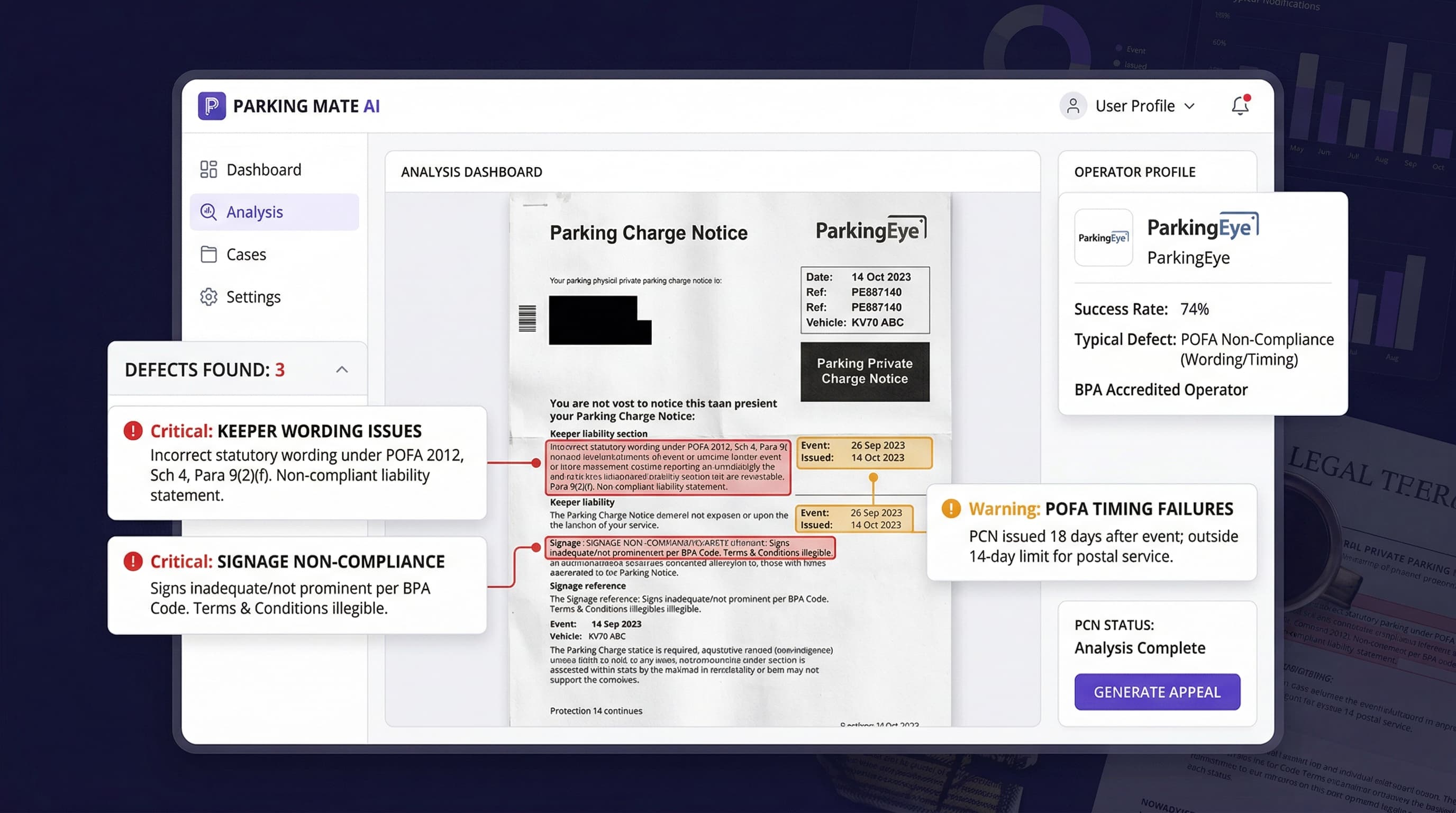
A county court claim from DWF Law means the parking charge is now being pursued through the courts. You will receive a claim form (N1) from the court. You must acknowledge it within 14 days and file a full defence within 28 days (from deemed service).
What a DWF Law court claim means for you
A county court claim from DWF Law means the parking charge is now being pursued through the courts. You will receive a claim form (N1) from the court. You must acknowledge it within 14 days and file a full defence within 28 days (from deemed service).
DWF Law must prove their case: adequate signage, valid contract, POFA compliance, and reasonable charge amount. Many parking charge court claims fail on one or more of these points. Do not assume you will lose simply because a claim has been issued.
Upload the court papers and Parking Mate AI will analyse the case for defects and produce a structured defence ready to file.
What we check on your case
Signage and notice wording
The signs at the car park and the wording on the original notice must meet specific legal standards. Missing or unclear signs are one of the most common defects.
POFA 14-day notice to keeper
The operator must serve a notice to keeper within 14 days. If this deadline was missed, the registered keeper may not be liable.
Charge amount
The charge must not exceed the cap set by the operator's code of practice. Excessive charges are a valid ground for challenge.
Procedural chain
Every step from original notice to enforcement letter must follow the correct sequence. Gaps or errors weaken the claim.
Evidence and information to keep together
The letter or notice from DWF Law
The original parking charge notice if you still have it
Any earlier letters, reminders, or replies
Photographs of signage at the car park if available
A note of all key dates in the sequence
Related pages
DWF Law Letter Before Claim
DWF Law threatening court action? A Letter Before Claim has strict deadlines. Check your defences and respond within 30 days.
DWF Law How to Respond
Step-by-step guide to responding to DWF Law. What to say, what to keep, and how Parking Mate AI can help draft your response.
All DWF Law Help
Return to the main DWF Law page for an overview of all help available.
DWF Law Court Claim FAQs
Common questions about this enforcement firm and how to respond to their letters.
What is a DWF Law county court claim?
A county court claim from DWF Law is a formal legal action to recover an unpaid private parking charge. You will receive a claim form (usually an N1) from the court, not from DWF Law directly. You must respond within the deadline or risk a default judgment (CCJ).
How long do I have to respond to a DWF Law court claim?
You have 14 days from deemed service to acknowledge the claim, and 28 days to file a full defence. Deemed service is 5 days after the claim is posted. These deadlines are strict. If you miss them, DWF Law can apply for a default judgment.
What should my defence to a DWF Law court claim include?
Your defence should address each point in the Particulars of Claim. Common grounds include: inadequate signage, POFA non-compliance, no valid contract, excessive charges, grace period failures, and generic or defective Particulars of Claim. The defence must be specific, not a general complaint.
What must DWF Law prove in court for a parking ticket?
DWF Law must prove: adequate signage was displayed, a valid contract existed between the motorist and the landowner, the charge is a genuine pre-estimate of loss or complies with the relevant code of practice, and all procedural requirements (including the POFA notice to keeper) were met. Failure on any point can lead to the claim being dismissed.
Do DWF Law court claims often succeed?
Many parking charge court claims are defended successfully, and some firms have a documented pattern of discontinuing claims rather than proceeding to trial. A well-structured defence that addresses the specific defects in the case significantly increases your chances. Do not assume you will lose simply because a claim has been issued.
What happens if I win against DWF Law in court?
If the court finds in your favour, the claim is dismissed and you owe nothing. You may be able to recover some of your costs. If the claim is discontinued by DWF Law before trial, the result is similar. A successful defence also prevents any CCJ from appearing on your credit record.
What happens if I lose against DWF Law in court?
If the court finds against you, a judgment will be entered for the amount claimed plus court fees. You will need to pay within the time specified. If you do not pay, it becomes a CCJ on your credit record for six years. However, you can apply to pay in instalments.
Can I settle with DWF Law out of court?
You can offer to settle at any time. Some firms accept reduced amounts to avoid the cost and risk of a trial. However, do not feel pressured to settle if you have a strong defence. Settling means paying something, whereas a successful defence means paying nothing.
What if I did not receive the original court papers from DWF Law?
If a default judgment was entered because you did not receive the claim form, you can apply to have the judgment set aside using form N244. You must show a good reason why you did not respond and that you have a realistic prospect of successfully defending the claim.
How does Parking Mate AI help with a DWF Law court claim?
Upload the court claim documents and Parking Mate AI analyses the case for defects. It checks the Particulars of Claim for errors, verifies the underlying parking charge for signage, timing, and procedural issues, and produces a structured defence ready to file with the court.
Need help with a DWF Law court claim?
Upload your letter for a free Parking Mate AI defect check. Most results are ready in minutes, and if grounds are found you can get a professional response letter straight away.
