Weymouth and Portland Order for Recovery: You Still Have Options
Weymouth and Portland has registered the debt at the Traffic Enforcement Centre. This is not a CCJ and does not affect your credit record. Upload your documents and Parking Mate AI checks your challenge routes.
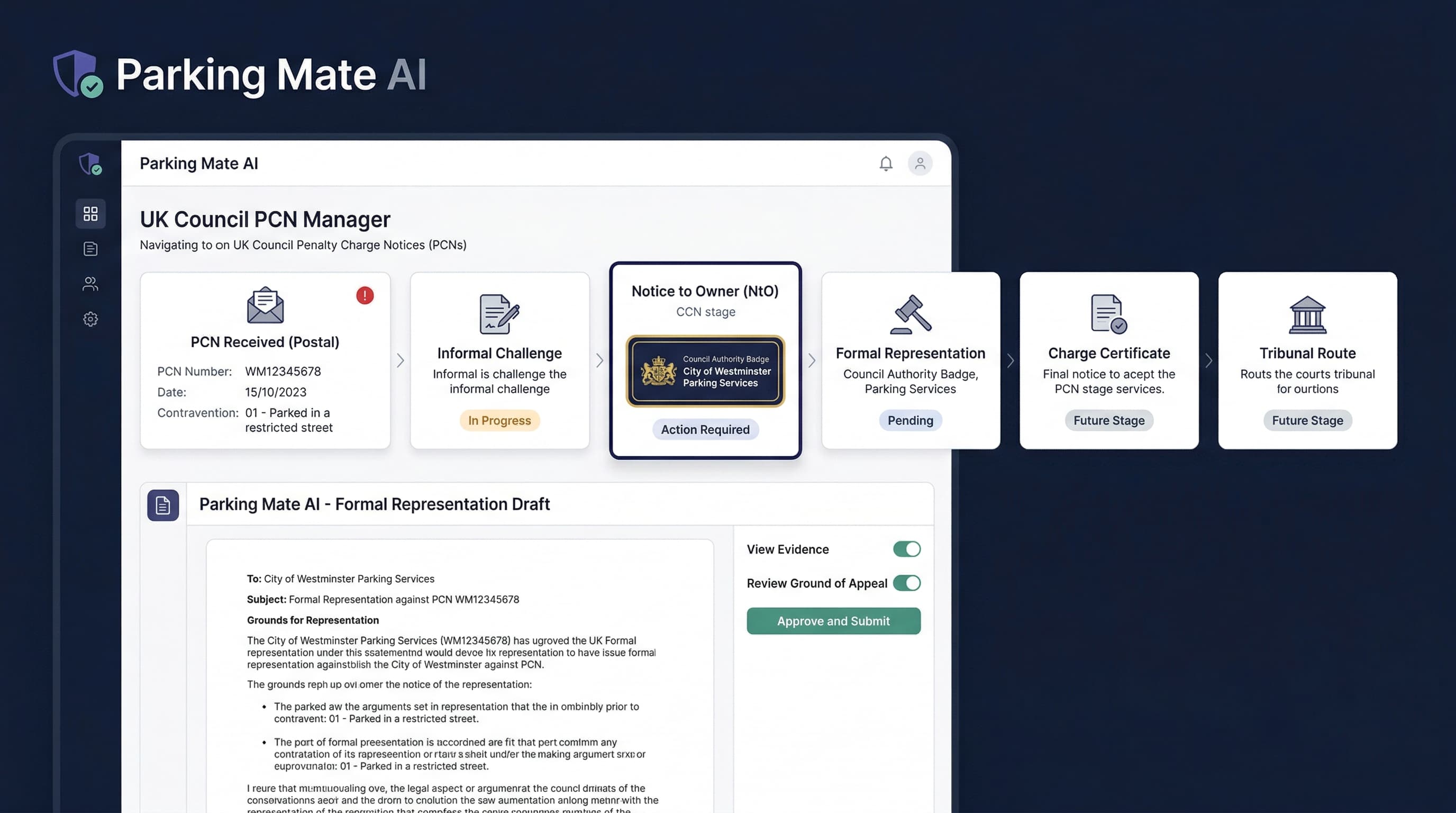
An order for recovery from Weymouth and Portland means Weymouth and Portland has registered the unpaid charge certificate debt at the Traffic Enforcement Centre (TEC). This is not a county court judgement and does not appear on your credit record. You can challenge it by filing a statutory declaration (TE9) if you did not receive earlier notices, or a witness statement (TE7) if there are other valid grounds. For parking contraventions you have 21 days; for moving traffic contraventions you have 36 days. Parking Mate AI identifies which route applies and prepares the paperwork.
What is a Weymouth and Portland order for recovery?
An order for recovery is issued after Weymouth and Portland registers an unpaid charge certificate debt at the Traffic Enforcement Centre (TEC). It is the stage between the charge certificate and bailiff enforcement.
Crucially, an order for recovery is not a county court judgement. It does not appear on your credit record. It is a debt registered under the Traffic Management Act 2004 through the TEC, which is a separate process from the county court system.
You can challenge an order for recovery by filing a TE9 statutory declaration (if you did not receive the PCN, notice to owner, or charge certificate) or a TE7 witness statement (if there are other grounds such as procedural errors in the original notice). If accepted, the order is revoked and the case reopens at an earlier stage.
Parking Mate AI analyses the original Weymouth and Portland PCN, checks the enforcement timeline, and identifies whether you qualify for a TE9 or TE7. If grounds exist, the service prepares the necessary documents for filing at the Traffic Enforcement Centre.
Weymouth and Portland order for recovery challenge grounds
Non-receipt of earlier notices
If you did not receive the Weymouth and Portland PCN, notice to owner, or charge certificate, you may qualify for a TE9 statutory declaration that revokes the order and reopens the case.
Procedural errors in original PCN
Defects in the original Weymouth and Portland penalty charge notice, such as signage failures, incorrect contravention codes, or service timeline errors, remain relevant at the order for recovery stage.
Incorrect registration at TEC
Weymouth and Portland must follow strict procedures when registering a debt at the Traffic Enforcement Centre. Errors in the registration process can form the basis of a TE7 witness statement.
Representations not considered
If you made representations to Weymouth and Portland that were not properly considered before the debt was registered, this can support a TE7 challenge.
Service to wrong address
If Weymouth and Portland sent enforcement notices to the wrong address, you may not have had a fair opportunity to respond at earlier stages. This supports a TE9 statutory declaration.
Evidence for your Weymouth and Portland order for recovery challenge
A copy of the order for recovery from Weymouth and Portland
Copies of the original Weymouth and Portland PCN, notice to owner, and charge certificate (if received)
Proof of address if Weymouth and Portland sent notices to an incorrect address
Any correspondence with Weymouth and Portland about the penalty
Evidence of defects in the original Weymouth and Portland PCN (photographs, signage, etc.)
Proof of a change of address if applicable (utility bills, tenancy agreement)
Other Weymouth and Portland PCN help
Weymouth and Portland Penalty Charge Appeal
Learn how to appeal a penalty charge notice from Weymouth and Portland.
Weymouth and Portland Charge Certificate Appeal
Learn how to challenge a charge certificate from Weymouth and Portland.
Weymouth and Portland Notice of Enforcement
Learn how to respond to a notice of enforcement from Weymouth and Portland.
Weymouth and Portland Bailiff Enforcement
Learn how to deal with bailiff enforcement for a parking debt from Weymouth and Portland.
Weymouth and Portland Bus Lane PCN
Learn how to appeal a bus lane penalty charge notice from Weymouth and Portland.
Weymouth and Portland Moving Traffic PCN
Learn how to appeal a moving traffic penalty charge notice from Weymouth and Portland.
Weymouth and Portland Restricted Street PCN
Learn how to appeal a restricted street penalty charge notice from Weymouth and Portland.
Weymouth and Portland Paid Parking PCN
Learn how to appeal a paid parking penalty charge notice from Weymouth and Portland.
Weymouth and Portland Permit Parking PCN
Learn how to appeal a permit parking penalty charge notice from Weymouth and Portland.
Weymouth and Portland Off-Street Parking PCN
Learn how to appeal an off-street parking penalty charge notice from Weymouth and Portland.
Weymouth and Portland Order for Recovery FAQs
Common questions about Weymouth and Portland order for recoverys and how Parking Mate AI can help.
What is a Weymouth and Portland order for recovery?
An order for recovery is a court-registered debt notice issued after Weymouth and Portland registers an unpaid charge certificate at the Traffic Enforcement Centre (TEC). It is not a county court judgement and does not appear on your credit record. It authorises the council to use bailiff enforcement if you do not respond within the deadline.
How do I challenge a Weymouth and Portland order for recovery?
You can challenge a Weymouth and Portland order for recovery by filing a statutory declaration (TE9) or a witness statement (TE7) at the Traffic Enforcement Centre. A TE9 is used if you did not receive earlier notices. A TE7 is used if there are other valid grounds. Parking Mate AI identifies which route applies to your case.
What is the deadline for responding to a Weymouth and Portland order for recovery?
For a parking contravention, you have 21 days from the date of a Weymouth and Portland order for recovery to file a statutory declaration (TE9) or witness statement (TE7) at the Traffic Enforcement Centre. For a moving traffic contravention, the deadline is 36 days. Missing these deadlines severely limits your options.
Does a Weymouth and Portland order for recovery affect my credit score?
No. A Weymouth and Portland order for recovery is registered at the Traffic Enforcement Centre, not at a county court. It is not a CCJ and does not appear on your credit record. However, if you do not respond, Weymouth and Portland can instruct bailiffs to collect the debt.
What is a TE9 statutory declaration for a Weymouth and Portland order for recovery?
A TE9 is a statutory declaration filed at the Traffic Enforcement Centre. You can use it to challenge a Weymouth and Portland order for recovery if you did not receive the penalty charge notice, notice to owner, or charge certificate. If accepted, it revokes the order and reopens the case at an earlier stage.
What is a TE7 witness statement for a Weymouth and Portland order for recovery?
A TE7 is a witness statement filed at the Traffic Enforcement Centre. It allows you to challenge a Weymouth and Portland order for recovery on grounds other than non-receipt, such as procedural errors in the original PCN. If accepted by the adjudicator, the order is revoked and the case reopens.
What happens if I ignore a Weymouth and Portland order for recovery?
If you do not respond to a Weymouth and Portland order for recovery within the deadline, Weymouth and Portland can instruct enforcement agents (bailiffs) to collect the debt plus their own fees. It is important to act within the deadline to preserve your challenge options.
Can Parking Mate AI help with a Weymouth and Portland order for recovery?
Yes. Parking Mate AI analyses your Weymouth and Portland order for recovery, checks for defects in the underlying PCN, and identifies whether you qualify for a TE9 statutory declaration or TE7 witness statement. If grounds exist, the service prepares the paperwork for filing at the Traffic Enforcement Centre.
Is a Weymouth and Portland order for recovery the same as a county court claim?
No. A Weymouth and Portland order for recovery is a debt registered at the Traffic Enforcement Centre under the Traffic Management Act 2004. It is completely separate from the county court system. It does not create a CCJ and does not affect your credit record. The challenge routes (TE9 and TE7) are specific to the TEC process.
Can I still challenge the original Weymouth and Portland PCN at the order for recovery stage?
Yes, indirectly. If you file a successful TE9 or TE7 in response to a Weymouth and Portland order for recovery, the case reopens at an earlier stage and you regain your right to make formal representations or appeal to Traffic Penalty Tribunal. Defects in the original PCN remain relevant throughout the process.
Need help with your Weymouth and Portland order for recovery?
Upload your notice from Weymouth and Portland for a free Parking Mate AI defect check. If grounds are found, get a professional order for recovery letter ready to send.
