Upload your notice
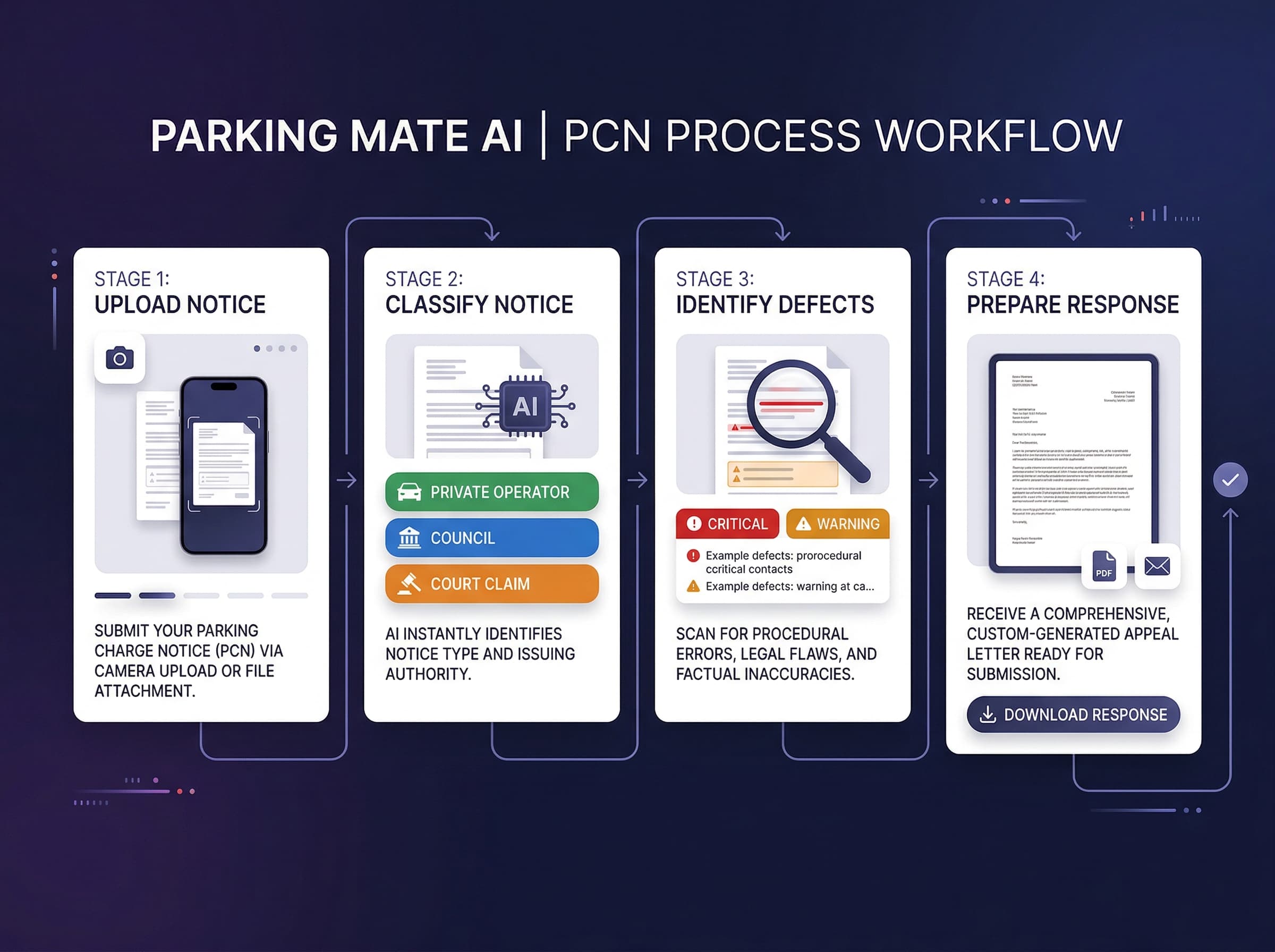
Take a photo of your parking ticket, penalty notice, or letter and upload it. Parking Mate AI reads and extracts the key details automatically.
ParkingEye is the UK's largest private parking operator. Their tickets must meet specific signage, timing, and wording requirements. Upload yours and Parking Mate AI checks for issues.
Ticket check
Parking charge notice defect check
Professional appeal letter
County court claim defence
Check a ParkingEye ticket for signage errors, timing issues, and wording defects specific to ParkingEye sites.
Learn moreAppealReady to appeal your ParkingEye ticket? Get a tailored appeal letter citing the defects found on your notice.
Learn moreCourtParkingEye taken you to court? Get a structured defence covering the grounds that matter in ParkingEye claims.
Learn moreThree steps from parking ticket to professional appeal letter. No legal jargon, no guesswork.
Take a photo of your parking ticket, penalty notice, or letter and upload it. Parking Mate AI reads and extracts the key details automatically.
Your notice is checked against signage rules, timing requirements, wording obligations, and procedural standards that the issuer must meet.
Receive a professional appeal or defence letter that cites the specific issues found, ready to send to the operator, council, or court.
Common questions about parking ticket appeals and how the service works.
You can appeal a ParkingEye ticket directly to ParkingEye within 28 days of the notice date. If ParkingEye rejects your appeal, you can escalate to POPLA (the independent appeals service for BPA members) for a free, binding review. A well-structured appeal citing specific defects on your ParkingEye ticket is far more effective than a generic complaint.
Yes. ParkingEye is one of the most litigious private parking operators in the UK and regularly files county court claims against motorists. However, ParkingEye must still prove their case in court, including that signage was adequate, the charge is reasonable, and they followed all required procedures. Many ParkingEye court claims are successfully defended.
ParkingEye is a member of the BPA (British Parking Association). This means ParkingEye must follow the BPA code of practice, and if they reject your appeal, you can escalate to POPLA for an independent review. POPLA's decision is binding on ParkingEye but not on you.
Yes. ParkingEye relies heavily on ANPR (automatic number plate recognition) cameras to record vehicles entering and leaving their car parks. The ANPR system calculates the length of stay and flags overstays. However, ANPR systems can make errors: misreads, failure to capture exits, and incorrect timestamps are all common issues that Parking Mate AI checks for.
Common defects on ParkingEye tickets include inadequate or poorly positioned signage at the car park, failure to serve the notice to keeper within the 14-day POFA deadline, ANPR errors such as missed exit reads, and charges that exceed the BPA code of practice cap. The specific defects vary by site, which is why a site-specific check matters.
Ignoring a ParkingEye ticket is riskier than ignoring tickets from most other operators because ParkingEye actively pursues county court claims. The safer approach is to check whether your ParkingEye ticket has defects and either appeal or prepare a defence, rather than ignoring it and risking a court claim or CCJ.
Under the Protection of Freedoms Act 2012, ParkingEye must serve a notice to keeper within 14 days of obtaining the keeper's details from the DVLA (or 14 days of the parking event if the driver's details are known). If ParkingEye misses this deadline, they may not be able to hold the registered keeper liable for the charge.
If ParkingEye rejects your appeal, you can escalate to POPLA within 28 days of the rejection. POPLA is free to use and provides an independent review. If POPLA finds in your favour, ParkingEye must cancel the charge. If POPLA upholds the charge, you can still defend any future court claim. The POPLA decision does not prevent you from raising defences in court.
ParkingEye's charges are capped by the BPA code of practice. The standard cap has historically been around £100 for most contraventions. If the amount on your ParkingEye ticket exceeds the applicable cap, that itself may be a ground for challenge. Parking Mate AI checks whether the charge on your notice is within the permitted limits.
Upload a photo of your ParkingEye ticket and Parking Mate AI identifies ParkingEye as the operator and applies ParkingEye-specific checks. This includes BPA code compliance, POFA timing rules, ANPR accuracy indicators, signage requirements, and charge amount limits. The result is a defect report and, if grounds are found, a professional appeal letter targeting the issues specific to your ParkingEye notice.
Upload your ParkingEye notice for a free defect check. If issues are found, get a tailored appeal letter or court defence.
